O DTx – Digital Transformation CoLAB encontra-se disponível para acolher candidatos interessados em submeter propostas ao concurso de Bolsas de Doutoramento da FCT 2026. A iniciativa visa apoiar investigadores que pretendam desenvolver projetos de doutoramento em estreita articulação com desafios reais da transformação digital.
Neste âmbito, o DTx disponibiliza enquadramento científico, orientação especializada e integração em projetos de investigação aplicados, promovendo um ambiente colaborativo entre a academia, indústria e setor público. Os candidatos selecionados terão oportunidade de desenvolver investigação de elevado impacto, contribuindo para a inovação e para a transferência de conhecimento em áreas estratégicas da transformação digital.
Atualmente, o DTx encontra-se paricularmente interessado em propostas de doutoramento nas seguintes áreas estratégicas:
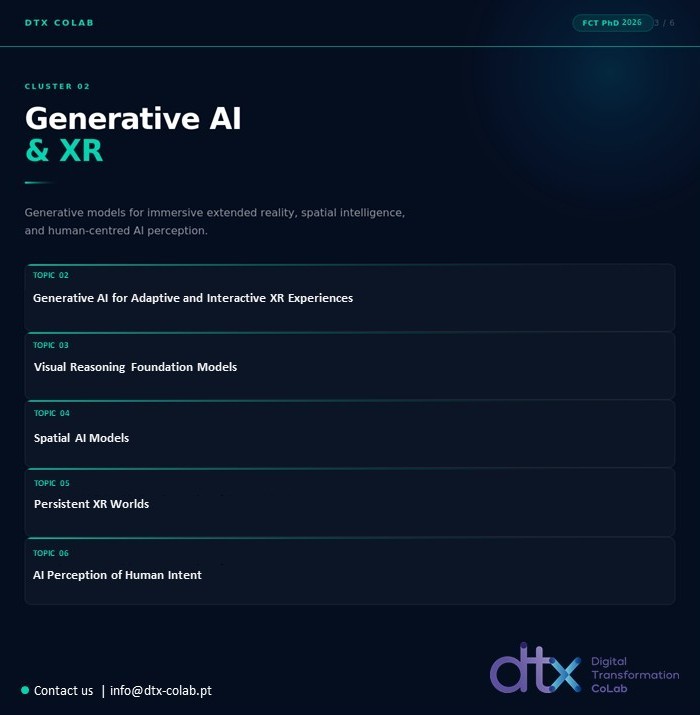
Generative AI & XR
– Generative AI for Adaptive and Interactive XR Experiences
Development of generative AI models that dynamically create and adapt XR experiences in real time based on user behavior and interaction.
– Visual Reasoning Foundation Models
Development of vision–language foundation models capable of structured visual reasoning over complex scenes, object relations, and multi-step visual inference.
– Spatial AI Models
Design of AI models that learn structured spatial representations of the physical world by integrating 2D perception, 3D scene understanding, and geometric reasoning.
– Persistent XR Worlds
Creation of persistent and shared XR environments through continuous visual mapping and real-time spatial reconstruction across multiple devices.
– AI Perception of Human Intent
Development of multimodal perception models capable of inferring and anticipating human intentions from visual observations, body pose, and contextual cues.
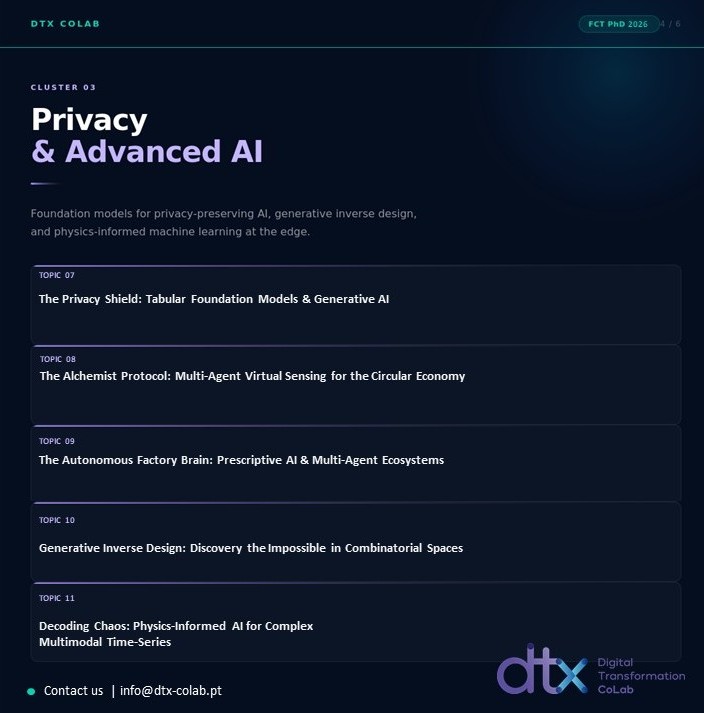
Privacy, Industry & Advanced AI
– The Privacy Shield: Tabular Foundation Models & Generative AI (Priority Area)
Benchmark and fine-tune universal generative architectures (Transformers, Diffusion, GANs) to synthesize high-fidelity, fully anonymized datasets that guarantee strict differential privacy. Utilize the “reverse paradigm” via pre-trained Zero-Shot generative architectures to execute instant, high-performance predictive modeling on new databases without requiring local parameter updates. Benchmark against leading commercial platforms, align with EU AI frameworks, and publish robust algorithmic research entirely in-silico.
– The Alchemist Protocol: Multi-Agent Virtual Sensing for the Circular Economy
Help decarbonize heavy industry by developing decentralized, agent-based architectures that model highly heterogeneous plant processes, like chaotic material mixtures. Leverage HPC and public material science databases to train custom “virtual sensors.” Orchestrate API-accessed Large Language Models (LLMs) to act as constrained reasoning engines, integrating Causal Machine Learning to guide cross-domain AI-assisted material formulation.
– The Autonomous Factory Brain: Prescriptive AI & Multi-Agent Ecosystems
Architect the Human-Agent interfaces over a Shared Cognitive Substrate. Orchestrate Foundation Models into a highly regulated topology of Intent, Coordination, and Assurance Agents. Core deep learning focus (via HPC) will be training and fine-tuning advanced temporal sequence models and Reinforcement Learning algorithms on distributed industrial sensor streams, exploring Federated Learning to aggregate intelligence across factory nodes. Leverage dynamic Knowledge-Graph retrieval and strict Explainable AI (XAI) to transparently enforce zero-defect operational envelopes.
– Generative Inverse Design: Discovering the Impossible in Combinatorial Spaces
Develop dual-track surrogate models to rapidly infer properties within vast combinatorial search spaces (e.g., advanced alloys/materials). Mitigate “cold-start” problems by generating automated computational data using open-source physical simulation libraries. Design human-in-the-loop Active Learning and Domain Adaptation pipelines to dynamically transfer in-silico generalized knowledge to sparse, real-world physical validation data.
– Decoding Chaos: Physics-Informed AI for Complex Multimodal Time-Series
Develop lightweight, physics-constrained machine learning architectures designed to decouple and interpret highly complex, overlapping signals in stochastic environments. Leverage self-supervised learning on massive unannotated public industrial benchmark datasets and synthesized multi-physics proxies. Utilize Cross-Domain Transfer Learning to create robust, noise-resilient models for extreme Edge AI and TinyML deployment.
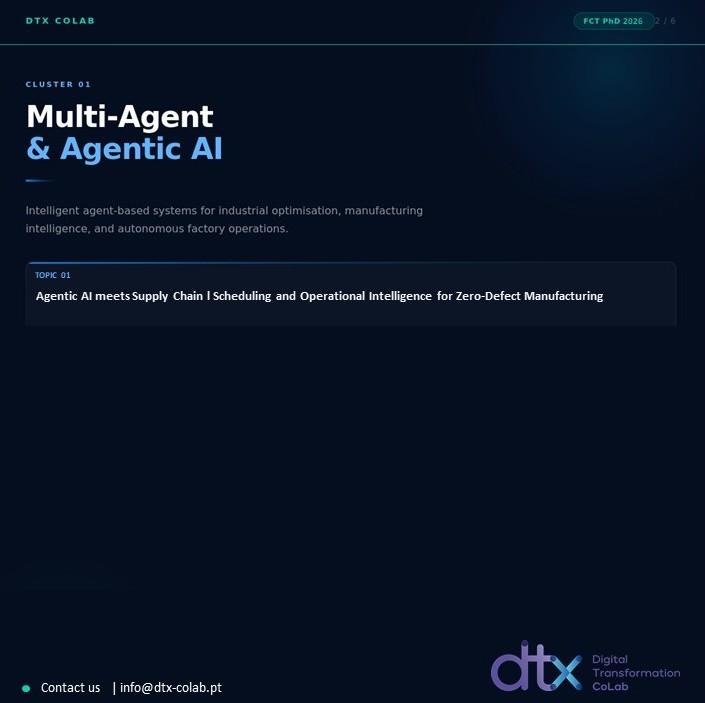
Multi-Agent Systems & Agent-AI
– Agentic AI meets Supply Chain, Scheduling and Operational Intelligence for Zero-Defect Manufacturing
Investigates how agentic AI systems can support optimisation across DTx network of partners (supply chains, manufacturing systems, and workforce coordination). The research will explore agent-based scheduling, planning, and decision-support systems capable of continuous optimisation in industrial environments. By integrating ML, optimisation methods, and industrial data streams, the project aims to enable operational intelligence, adaptive production scheduling, and optimising industrial ecosystems aligned with the intelligent factories.
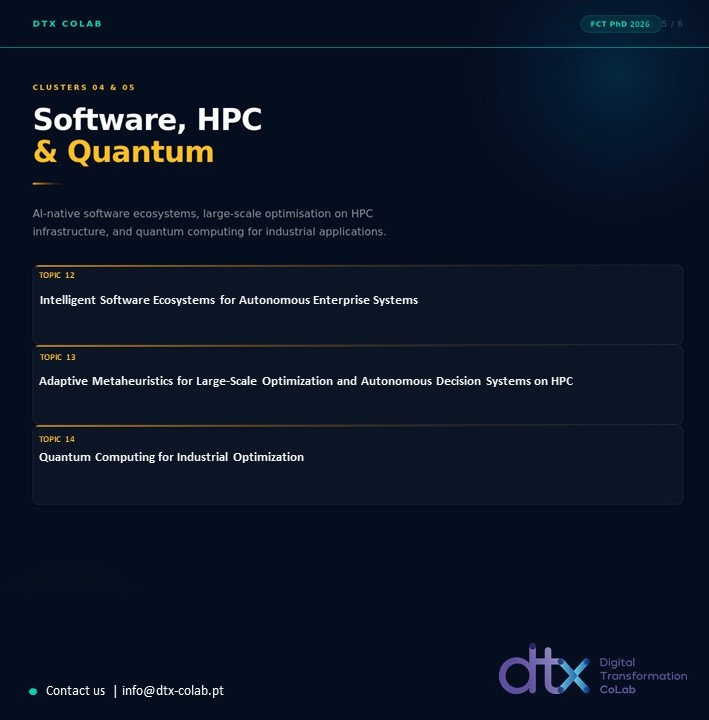
Software, Scheduling and HPC
– Intelligent Software Ecosystems for Autonomous Enterprise Systems
Investigates the designing AI-native software ecosystems where intelligent agents orchestrate enterprise services, developer tools, and operational systems across both backend and frontend software layers. The project will explore agent ecosystems capable of coordinating APIs, services, and development workflows, including AI code assistants, automated code transformation, and software summarisation to accelerate application development and maintenance.
– Adaptive Metaheuristics for Large-Scale Optimisation and Autonomous Decision Systems on HPC
Explore adaptive metaheuristic frameworks for solving large-scale optimisation problems in engineering and industrial systems. The project will develop learning-based optimisation methods capable of addressing scheduling and resource allocation under uncertainty, potentially integrated with Digital Twins, High Performance Computing (HPC) infrastructures, and distributed computing environments.
Quantum Technologies
– Quantum Computing for Industrial Optimisation
Investigate how quantum computing and quantum-inspired algorithms can solve complex industrial optimisation problems in areas such as production planning, logistics, and resource allocation. The project will assess practical use cases, benchmark performance against classical methods, and explore pathways for industrial adoption at DTx.
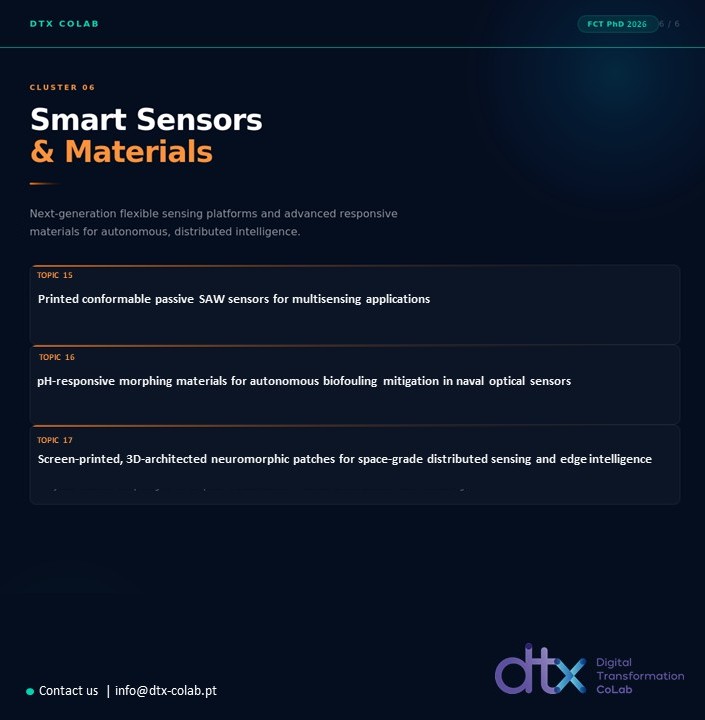
Smart Sensors & Advanced Materials
– Printed conformable passive SAW sensors for multisensing applications
Development of fully polymeric, flexible, wireless SAW sensing platforms for simultaneous detection of temperature, humidity, strain, and gases, using screen-printed piezoelectric polymer architectures.
– pH-responsive morphing materials for autonomous biofouling mitigation in naval optical sensors
Design and fabrication of 4D-printed bilayer hydrogel systems that autonomously detach early-stage marine biofilms from submerged optical sensors by converting local biochemical signals into controlled surface deformation.
– Screen-printed, 3D-architected neuromorphic patches for space-grade distributed sensing and edge intelligence
Development of flexible neuromorphic patches combining 3D-printed mechanical microstructures with screen-printed memristive and ionic-electronic synaptic devices, implementing physical reservoir computing for on-tile pattern classification in robotics and structural health monitoring.
Os candidatos selecionados terão oportunidade de desenvolver investigação aplicada em ambiente colaborativo, com acesso a projetos em curso, parcerias industriais e uma equipa multidisciplinar.
O DTx CoLAB é um laboratório colaborativo focado na investigação e desenvolvimento de soluções digitais para a transformação de organizações e da sociedade, trabalhando em estreita colaboração com universidades, centros de investigação e parceiros industriais.
Para mais informações ou manifestação de interesse, os candidatos podem contactar: info@dtx-colab.pt.